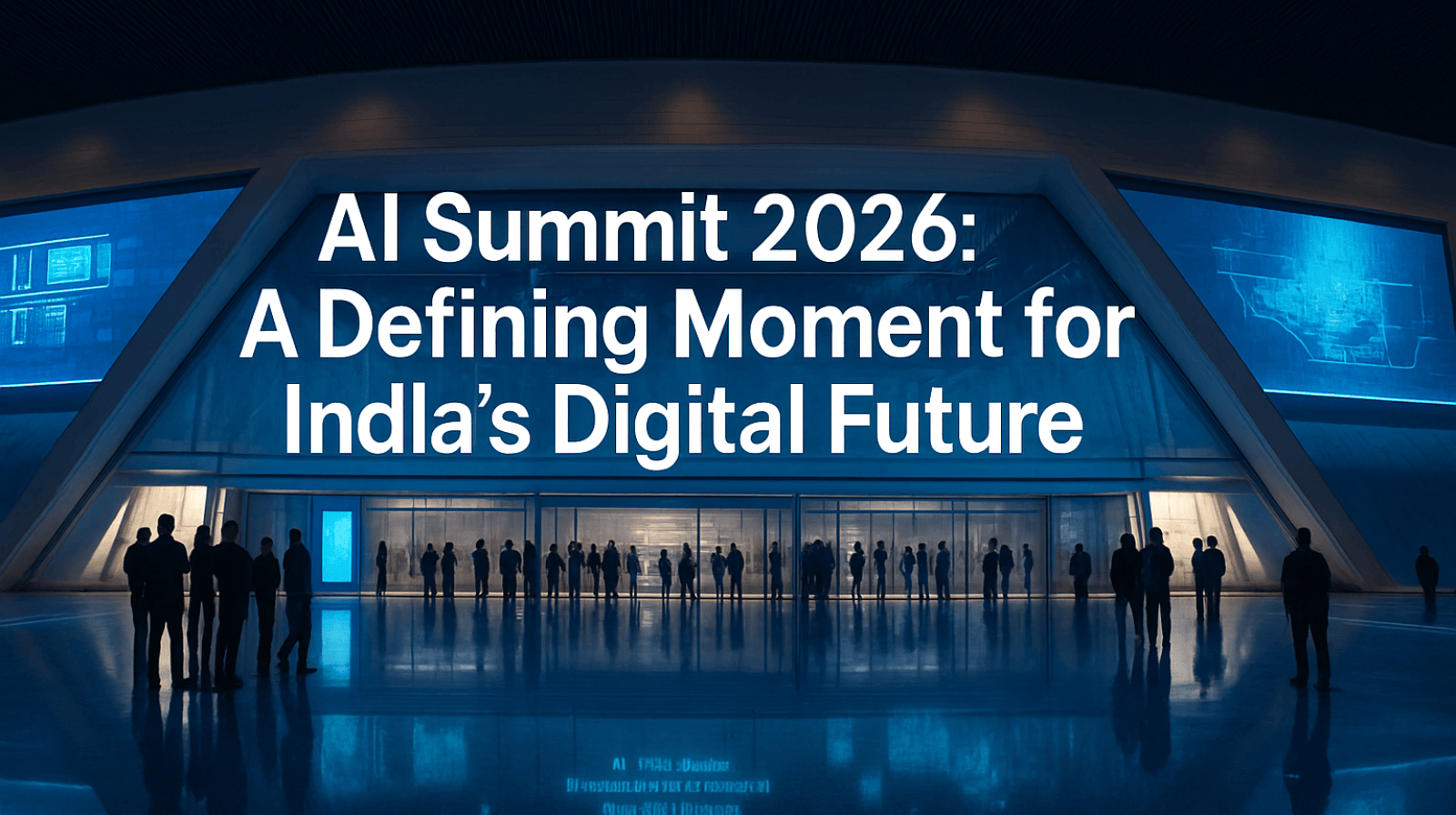
A technology company’s perspective on the AI transformation wave
The AI Summit 2026 Delhi has emerged as one of the most consequential technology gatherings in recent years. Held at Bharat Mandapam in New Delhi, the AI Impact Summit 2026 reflects a larger national movement — positioning India not merely as a consumer of Artificial Intelligence but as a creator, regulator, and exporter of AI capabilities.
From a software company’s standpoint, this summit was not just another technology exhibition. It was a policy signal, a market direction indicator, and a business roadmap combined.
AI in 2026 is no longer experimental — it is infrastructure.
Why the AI Summit is Happening Now
The AI Summit 2026 Delhi is being organized at a defining moment in the global technology cycle. Artificial intelligence is no longer a research topic or experimental enterprise tool — it has become national infrastructure. Governments, enterprises, startups, and academic institutions are aligning strategies around AI adoption, and the AI Impact Summit 2026 reflects this transition.
Across artificial intelligence news globally, one trend is clear: the countries that standardize AI early will lead the next digital economy. India 2026 is positioning itself not just as a participant but as a platform where scalable AI systems can be built for billions of users.
1. Economic Competitiveness in the AI Economy
The global market is entering an AI-driven productivity cycle. Businesses are shifting from manual workflows to AI-assisted decision systems — in finance, healthcare, logistics, agriculture, and governance. The AI Summit brings policymakers and technology companies together to align regulatory frameworks with industrial innovation.
For India, this is about moving from IT services to AI products. Instead of exporting development hours, the country aims to export AI platforms, datasets, and domain-trained models. The summit demonstrates India’s readiness to become an AI solution provider for emerging economies.
2. Workforce Transformation and Skill Realignment
The workforce transformation triggered by generative AI is deeper than previous automation waves. Software developers are transitioning into AI supervisors, analysts into decision architects, and support teams into automation operators. Institutions like AICTE are working to standardize AI education so graduates are industry-ready.
The AI Summit 2026 highlights how engineering education, corporate training, and startup ecosystems must integrate. Instead of learning programming alone, professionals now require understanding of prompting, model evaluation, data pipelines, and human-AI collaboration workflows.
3. Governance, Public Infrastructure and Responsible AI
Governments globally are shifting toward sovereign AI infrastructure — meaning AI systems that operate within national regulatory and ethical frameworks. The summit focuses on transparency, bias control, multilingual accessibility, and citizen-centric digital services.
India’s strategy is unique: deploying AI in population-scale platforms such as public services, digital identity ecosystems, and citizen support systems. This ensures AI benefits are not limited to enterprises but reach startups, small businesses, and rural users.
The AI Summit therefore is not only a technology event — it is a governance blueprint showing how artificial intelligence can be embedded into national development.
Role of Policy and Government Direction
The event strongly highlighted the government’s AI-first approach focusing on three pillars:
- AI for public infrastructure
- AI for startups and innovation
- AI for citizen services
Artificial Intelligence should empower every citizen rather than create a divide between creators and consumers.
Participation from Academia and Institutions
The presence of AICTE reinforced that the summit is not just about industry — it is about talent pipeline development.
- AI curriculum modernization
- Industry-linked research labs
- National AI internship programs
- Applied AI engineering certifications
For software companies, this directly impacts hiring quality and reduces training cycles.
Major Industry Leaders and Their Observations
Executives, founders, and researchers across cloud, SaaS, robotics, and semiconductor sectors shared a common sentiment: India is transitioning from an outsourcing hub to an AI solutions hub.
Global Leaders
- Sundar Pichai — CEO, Google (USA)
“India’s multilingual data diversity makes it one of the most important regions for building inclusive AI systems at population scale.” - Sam Altman — CEO, OpenAI (USA)
“The next breakthroughs in applied artificial intelligence will come from countries deploying AI across public infrastructure — and India is moving very fast in that direction.” - Jensen Huang — CEO, NVIDIA (USA)
“India is transitioning from a software services powerhouse into an AI engineering powerhouse.” - Arvind Krishna — CEO, IBM (USA)
“Enterprise adoption of AI requires trust, governance and scale — and India is building all three simultaneously.” - Satya Nadella — CEO, Microsoft (USA)
“AI will redefine productivity, and India’s developer ecosystem will be central to building global solutions.”
Business Benefits of the AI Impact Summit 2026
Faster Enterprise Adoption
Enterprises gain clarity on compliance and regulatory frameworks — reducing hesitation in deploying AI in production environments.
Product Opportunities
- AI copilots for SMEs
- Industry-specific models
- Regional language AI platforms
- Government digital infrastructure systems
Startup Ecosystem Expansion
The summit signals investor confidence and reduced market risk.
Talent Standardization
Educational alignment with industry requirements reduces onboarding cost and training cycles.
Long-Term Impact on the Software Industry
Development Lifecycle
AI-assisted development will become default, while engineers focus on architecture and validation.
Product Design
Applications will evolve from feature-based software to decision-based software.
Client Expectations
Clients will not ask if a system supports AI — they will ask how deeply AI is integrated.
Conclusion
The AI Summit 2026 Delhi is not merely a conference — it is a declaration of technological direction.
Artificial Intelligence in 2026 is transitioning from innovation to infrastructure, from capability to necessity, and from experimentation to governance.
AI is no longer a feature — it is the operating layer of digital systems.
Organizations that adapt will scale. Organizations that delay will integrate late at higher cost.
Recent Posts



📂 Categories
- Artificial Intelligence (1)
- Digital Marketing (3)
- Mobile App Development (1)
- SEO (1)
- Social Media Marketing (3)
- Tech Industry News (1)
- Website Development (6)
- WhatsApp Marketing (6)
🏷️ Tags
AI Tools Automation Chatbots Click to WhatsApp Ads Content Strategy Customer Engagement Customer Support improve wordpress website speed Influencer Marketing Lead Generation Meta Ads Social Media Trends UI/UX website loading slow wordpress WhatsApp API WhatsApp Business WhatsApp Marketing WordPress wordpress performance optimization wordpress speed optimization
📢 Subscribe
Get the latest social media marketing insights directly in your inbox.